

THE ENCHANTED NATURE NEWSLETTER

Issue 51
February 2026
Greetings Enchanted Nature Community
Winter has settled over the Shenandoah Valley and we find ourselves beneath a frozen blanket of icy snow; silent, still, and yet full of presence.
Our daily routines are slower and reshaped, reminding us of a simple truth:
nature is always in charge, and we are always its humble students.
Whether it’s the intensity of summer heat, the sudden fury of wildfires, the relentless rise of floods, or the inconvenience of snow, the weather has a way of humbling us. In these moments, we are reminded of the delicate balance of life, our fragility, and the profound beauty in the rhythms of the natural world.
As John Muir once reflected, “In every walk with nature, one receives far more than he seeks.” Even a look out the window can be insightful.
Try to find enchantment in nature in any way that you can.
We hope you find joy, insight, and inspiration in this latest issue of
The Enchanted Nature Newsletter.
Sailing Through Turbulence

Lovely weather so far. I don't know how long it will last,
but I'm not afraid of storms, for I'm learning how to sail my ship. — Louisa May Alcott
The world has felt unusually turbulent these past months. Across the nation, currents of unrest swirl in ways that are hard to navigate, leaving many of us unsettled. These times test our patience, compassion, and resilience, challenging the very foundations on which we try to build our lives. Yet, as in nature, turbulence is not the end of the story. It is a phase in a larger cycle.
Nature is often in what seems like disorder or even destruction: a wildfire sweeps through a forest, a river floods its banks or a storm topples trees. At first, it is unsettling and jarring, but over time, the landscape heals. New growth emerges from charred soil, rivers carve new paths, and forests return stronger and more diverse than before. As John Muir wrote, “The mountains are calling, and I must go; and I am content to live in the midst of their turbulent beauty.” Life, like nature, contains turbulence but in its midst, there is growth, beauty, wisdom, and renewal.
Amid these currents, there are acts of care, courage, and quiet service that often go unseen. People showing kindness to strangers, defending the vulnerable, working to heal communities and create ripples of calm within the storm.
Those who nurture the land, protect ecosystems, and advocate for justice ensure that even in the face of upheaval, life continues and thrives.
As we move forward into 2026, may we remember that turbulence is not our enemy. It can teach us, shape us and reveal resilience we did not know we had. May your year be filled with opportunities to learn, to nurture and to witness the harmony that emerges after storms: both in nature and in our lives.
We wish you health, peace, and enchanted moments in the year ahead.
From Our Readers
We sincerely appreciate your contributions!
Your photos make The Enchanted Nature Newsletter more interesting for the entire Enchanted Nature community.
If any of you see anything enchanting in nature, take a picture and please send it along.
Jack Wilson submitted this amazing photo from one of his recent adventures.
First, this photograph is a stunningly beautiful ecosystem of moss, a boulder with various lichens, leaves from a variety of hardwood tree species, a Whiteflower Leafcup (Polymnia canadensis) which is native to Virginia and some Turkey Tail (Trametes versicolor) mushrooms emerging from the moss.
Unless this is an evolved species of a Trametes fungi that can dissolve rock, there must be some kind of decaying wood hidden beneath the moss because Trametes versicolor
requires both cellulose and lignin (the components of wood) as food to survive.
FANTASTIC pic Jack! Thank you for sharing it with the Enchanted Nature Community.

Pam Lily shared this pic of a snow covered farm. Look to the left and you'll see a couple of goats braving the elements. I sure hope their coats are made of wool!
Thank you for sharing this lovely scene Pam.
It makes me long for the green pastures of spring.

Eileen Feim contributed some enchanting photos this month.
Below is what appears to be a Polyphemus or Luna moth cocoon.
These cocoons often fall to the forest floor in the autumn, where they remain hidden among the leaf litter until the moth emerges in the spring or summer.

For those of you interested, below are images of a Polyphemus Moth and Luna Moth respectively


This had us stumped and after discussing the pic with Eileen and putting together her research and ours, it is not a fungus. It is either "stemflow" which appears after rain following a dry spell and is a natural, harmless phenomenon caused by rain mixing with accumulated atmospheric pollutants, dust, and natural, soap-like compounds within the bark. This "stemflow" mixture creates suds as it flows down rough, furrowed bark. Unfortunately, the other likely candidate is that this pic shows the frozen sap of the tree escaping from damage done by a beetle that prefers Pine such as the Pine Engraver, Southern Pine Beetle, or Red Turpentine Beetle.
Fun Pics Eileen! Thanks for sharing with the community.
Thank you for your submissions! May the forest be with you.
Remember, if you can't get enough fungal fun,
stop in and see us at The Necessary Mercantile
Please send us your pics and queries:
adventures@enchantednaturetours.com
You can also text your pics & questions to (540) 324-8778.
From The Writers
One of our favorite enchanting activities after a snow is finding wildlife tracks.
These clues are evidence left by a squirrel.

Cold enough to freeze a creek and still enchanting

Recovery in Difficult Times
By: Victoria and Christopher Vacher
Recovery and the Hidden Architects of the Earth
Recovery in natural ecosystems often begins underground. Beneath the visible forest and fields, mycelium does the real work. Thread by thread, it weaves healing connections that no one sees nor applauds. Mycoremediation at its finest, these fungal networks decompose organic matter, create new topsoil, and redistribute critical resources such as water and nutrients; even under stressed or disturbed conditions. This could almost be called the forest's Red Cross. Plants and trees that appear to compete above ground are quietly cooperating below, sugars sent to struggling neighbors, warnings passed about danger, strength redistributed where it is most needed. Nothing flashy happens. No single mycelial strand takes credit, yet the entire forest becomes stronger, harder to starve, harder to burn, harder to kill.
These underground processes are driven by vast networks of mycelium: the thread-like filaments of fungi that link plant roots, soil, and decomposing organic matter into living webs. Through these connections, nutrients, moisture, and chemical signals move across landscapes, enabling plants to survive drought, disturbance, and nutrient scarcity. Mycelium is often referred to as the "Wood Wide Web", a term coined by: David Read (mycologist, University of Sheffield) and popularized by: Suzanne Simard (forest ecologist, UBC)
By connecting diverse species, fungi generate ecosystem-wide resilience,
allowing forests, meadows, and wetlands to recover with remarkable efficiency.

Another characteristic in some fungi that is central to these systems are arbuscules, which are microscopic, tree-shaped structures formed within plant root cells at the connection point of the roots and mycelium. Arbuscules act as nutrient-exchange interfaces where mycorrhizal fungi deliver phosphorus, nitrogen, and trace minerals to their plant hosts while receiving carbohydrates in return. Saprophytic fungi complement this exchange by decomposing fallen wood, leaf litter, and organic debris, converting complex materials into bioavailable nutrients. Together, these cooperative actions build soil structure, foster biodiversity, create fertile microhabitats for seedlings, and sustain long-term ecological stability. Arbuscular fungi do not produce mushrooms.
Humans, like fungi, have an underground life. It exists in that teachers go the extra mile with students and classrooms; neighbors trading skills and supplies without calling it charity; organizers, artists, craftspeople, and listeners reinforcing one another across invisible lines. Like fungal networks, they do not wait for votes or consensus. They recognize stress and respond, passing along what they can so collapse does not spread unchecked. These decentralized, cooperative systems mirror the logic of mycelium: quiet, adaptive, and profoundly effective. No matter how small your contribution may seem, it does contribute to the overall good if that is your intention.
Humans can also reinforce ecological recovery more directly through mycoremediation (the use of fungi to clean and restore degraded environments). Fungal metabolism can break down toxins, immobilize heavy metals, and rebuild soil health. When paired with native plant restoration and conditions that support fungal growth, these efforts amplify the same principles fungi have refined over evolutionary time: connectivity, nutrient cycling, and repair. Such interventions succeed best when they complement existing biological systems rather than override them.
Recovery is not a dramatic spectacle but a patient, persistent process: one strand, one act, one connection at a time. By aligning with the intelligence and resilience already present in nature, we can help ensure that forests, soils, waterways, and human societies alike endure, flourish, and heal in ways that are lasting and profound.

Enchanted Nature News
We discuss fungi quite a lot in the Enchanted Nature Newsletter.
Please remember to never eat a wild mushroom unless you are 100% positive of what it is
and have fully considered the risks of an identification error.
There have been quite a few mushroom poisonings in the US lately.
Here's one example:
Learn A New Skill With
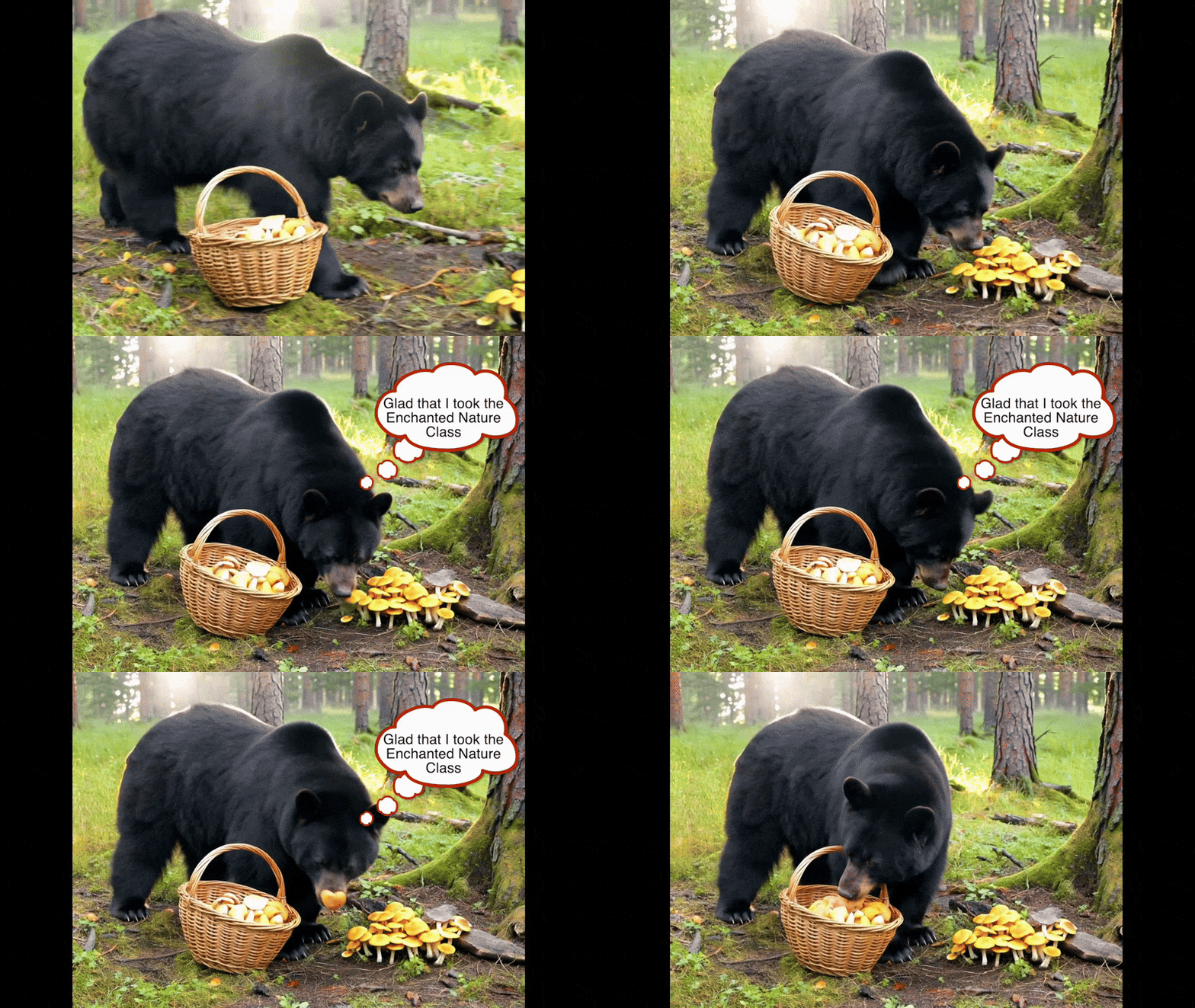
Enchanted Nature's Introduction to Mycology and Mushroom Foraging Class
Sunday, February 8th, 2026
For those of you in the region, stop in to see us and our products at
3816 Churchville Avenue
Churchville, VA 24421
Thursdays, Fridays and Saturdays 10am-2pm

Enchanted Nature Mushroom Extracts:
Small batch, full spectrum
extracts made with whole fruiting bodies.
We source, forage or grow the mushrooms locally.
Our extracts can be purchased at:
The Necessary Mercantile, The Cheese Shop, Polyface Farms or
you can order on The Enchanted Nature Trading Post


Fungal Fruits
Mushrooms are the "fruits" of a fungi. They are amazing in that some provide medicine while some have the ability to make us sick or worse. Some are delicious while others are inedible. The diversity of the fungal kingdom is absolutely enchanting and the video below illustrates this beautifully with time-lapse videography.
Findings reported in the International Journal of Environmental Research and Public Health, suggest that keeping a few snapshots of greenery around yourself might be beneficial. When participants viewed the natural images in the experiment, their stress levels lowered, thanks to the activation of their parasympathetic nervous system – which controls certain rest functions. "Viewing green scenes may thus be particularly effective in supporting relaxation and recovery after experiencing a stressful period and thereby could serve as an opportunity for micro-restorative experiences and a promising tool in preventing chronic stress and stress-related diseases."
Take a deep breath, hold it, and let it out slowly as you relax.
NATURE IS CALLING, WILL YOU ANSWER
There are many proven health benefits to spending time in nature. It has also been proven that just looking at images of nature can provide multiple health benefits including: reducing depression, speeding healing, improving your immune system, preventing dementia, improving your mood, and increasing happiness. We plan on ending each newsletter with a short video of a natural scene. Hopefully the videos will provide you with some of the benefits listed above.