

THE ENCHANTED NATURE NEWSLETTER

Issue 52
Spring 2026
From the Forest,
Welcome Enchanted Nature Community
Early spring wildflowers have now finished their show and the dense greens have changed the verdant hue of the entire landscape.
Moving forward, to keep our newsletter ad free and free to you, we will be publishing four seasonal newsletters. We hope that you enjoy this spring issue of
The Enchanted Nature Newsletter.
Reality, Authenticity and Connection
“A bird does not sing because it has an answer. It sings because it has a song.” — Maya Angelou
Many people are spending their time, our most precious commodity, on what flows through glowing screens, watching endless doses of digital media. In these spaces, reality is curated, accelerated, and constantly creating dissonance. It is shortening our attention span. There are trolls and bots looking to cause argument, upset and disconnection. If you're one of them, please stop! Nature is waiting for you to spend your time more productively. Social media, streaming platforms, 24 hour news, and other virtual mediums have become the primary way many consume information and entertainment, and has even become their main form of connection.
The challenge is not that these tools exist, but how much of our time and attention they covertly absorb. It can often come at the expense of what is real, grounded, and physically present.
It would also be remiss to dismiss “reality” itself as an unquestioned good. Work and financial demands, personal responsibilities, the people closest to us, and the constant awareness of global events can at times feel absolutely overwhelming. Real life, in its entirety, is not always gentle. Nature is waiting to help manage the stress.
Hearing the song of birds is a gift of nature. Birds are not performing for validation from others. They sing because they have a song to express. It's in their "nature". The bird doesn't care how many "likes" it will receive. Not everything we do needs to be logical, justified, or outcome driven. Things like creating music, drawing, painting, sharing, or even building something meaningful can come from an inner truth that just needs to be expressed.
Authentic connection is what we want to encourage you to consider. When musicians "jam" together, there is an authentic connection and usually if there are listeners in the room, they'll feel the connection too. It becomes a group experience, not a performance.
Walking in nature is real and authentic and you will feel a connection: to the birds, the trees, the flowers, the wind and every sensation. Whether it is your own yard, an urban park or a wilderness, we encourage you to never lose sight of creating real, authentic connections with yourselves, the planet, and others. Maybe whistle a tune back to the bird you hear singing...
From Our Readers
We sincerely appreciate your contributions!
Your photos make The Enchanted Nature Newsletter more interesting for the entire Enchanted Nature community.
If any of you see anything enchanting in nature, take a picture and please send it along.
Jack Wilson shared a couple of nice photos.
In the first pic, we find a rhizome and leaves of Solomon's Seal (Polygonatum biflorum).
Solomon’s seal is a shade-loving woodland perennial. It spreads slowly through rhizomes, forming elegant arching stems that are lined with paired leaves. The blooms are small, hanging white flowers that later become dark blue berries. It has a long history in herbal traditions for supporting joint health and inflammation, though it should be used cautiously and properly identified because it can be confused with toxic look-alikes in the forest understory.
.jpg)
The next photo appears to be a cuckoo bee in the
genus Nomada, often just called Nomad bees.
Because they are cleptoparasites, meaning they lay their eggs
in the nests of other ground-nesting bees,
they have evolved to look remarkably like small wasps.
Here are a few features that give it away:
-
Wasp-like appearance: They have smooth, slender bodies with distinctive yellow, red, or dark bands and very little hair. Since they don't collect pollen for their young (they steal the host bee's food stores), they lack the fluffy pollen-carrying hairs (scopa) found on most other bees.
-
Thick, reddish antennae: Notice those prominent, slightly curved antennae with a reddish tinge, which are classic for many Nomada species.
-
Spring timing: They are very active early in the season, precisely when their spring-emerging host bees are busy digging nests.
They are fascinating, stealthy little operators of the pollinator world.
Thanks for sharing your fantastic macro shot and interesting find Jack.
.jpg)
Sue Gaeta contributed an enchanting photo of a
Regal Moth caterpillar, Citheronia regalis (also called the hickory horned devil) it is one of the largest caterpillars in North America, found in the eastern United States and feeding on trees like hickory, walnut, and sweetgum. Despite its intimidating size and dramatic horns, it is completely harmless to humans and eventually transforms
into a striking orange and gray moth. Excellent Find Sue! Thank you for sharing.

Here are a couple of pics from the web that show a closer look at the caterpillar and the Regal Moth.


Kayla Skey sent a lovely photo of a statuesque Great Blue Heron (Ardea herodias)
perched in a Sycamore tree (Platanus occidentalis).
The Great Blue Heron can swallow prey whole, including fish, frogs,
and even small mammals thanks to its highly flexible neck and specialized throat.
Beautiful pic Kayla. Thank you!

Eileen Feim sent a photo of a beautiful orange jelly fungus. What is particularly interesting about this mushroom is it could be two species and we need a little more info to identify it.
Whether it is growing on hardwood or conifer wood matters. Tremella mesenterica which grows on hardwoods or Dacrymyces chrysospermus which prefers conifer wood.
We could also identify the fungus with microscopic analysis.
The Dacrymeces is a saprobe, meaning that it decays organic matter. The Tremella is actually a mycoparasite, meaning that it feeds on another fungus, in this case, usually Peniophora crust fungi. In the field, we would try to identify the type of wood and search the nearby area for any crust fungi growing to confirm an identification. Nice pic Eileen! Thank you.

Jeanne Dimerling submitted a couple of wonderful wildlife photos.
WOW! What a striking contrast these three male Cardinals make against the snowy landscape.
The Cardinal is Virginia's state bird and may have one of the easiest
taxonomic names to remember: Cardinalis cardinalis


Another WOW!!! picture. This stunning photo appears to be a
Juvenile Bald Eagle (Haliaeetus leucocephalus) camouflaging itself amongst
branches while scoping out potential prey. During the winter, juvenile bald eagles from northern climates migrate to Virginia's unfrozen waterways, where they often gather in
large numbers to a communal roost and cooperatively scavenge for food.
Thank you for sharing the outstanding ornithological photographs Jeanne.
Thank you all for your submissions! May the forest be with you.
Remember, if you can't get enough fungal fun,
stop in and see us at The Necessary Mercantile
Please send us your pics and queries:
adventures@enchantednaturetours.com
You can also text your pics & questions to (540) 324-8778.
PLEASE INCLUDE YOUR NAME SO THAT WE CAN SAY THANK YOU
From The Writers
We are making progress with our mycological magic. The Enchanted Nature laboratory is complete and for all of you that contributed to this success, we can't thank you enough!
Again, THANK YOU to all of you who helped make this happen.


Here is a closeup of mycelium working its way through the growing medium
in what will eventually produce Oyster mushrooms.
Fungi is like our "livestock" as mushroom farmers and
the excitement of watching the mycelium run never gets old.

Fruits of the mycelial labor - Pleurotus ostreatus
Nature’s Chorus: How Birds Shape Our Well-Being
By: Victoria Vacher
We are, and always have been environmentally minded, tree-hugging, wildlife lovers. Several months back we became extraordinarily aware of the importance of nature to human well being. We experienced a strange occurrence on our property, which is in a rural, forest setting and is always rife with wildlife. For the better part of six weeks the birds, squirrels and chipmunks that we usually have in abundance left our yard. It took a beat for us to realize that something was off and even longer to understand that it was the lack of our critters. It was uncanny and frankly frightening, reminiscent of the conditions horror movies open with. I called our neighbors and all was well on their properties. We still do not know what caused the exodus. Chris blames a couple of feral cats that had been seen on our property for a while. Several scenarios occurred to us that might explain it, but we will most likely never know what actually happened. We were incredibly pleased when they started to return and this event heightened our awareness of how important wildlife is to human feelings of well being.
Shinrin-yoku (Forest Bathing) has become a common term in the past few years and we wondered how large a part the birds played in the experience. They are undoubtedly integral to the outdoor experience.
Then a very good friend of ours introduced us to the birding apps. Birds are dynamic, unpredictable, interactive, intriguing and so much fun to learn about. We can’t say that we are true "birders" in any sense of the word, but our experience kicked our bird interest into high gear and we are enthusiasts working towards becoming birders.
As the newsletter always states get out into nature for your health.
Listening to the birds is a huge part of that experience.
Our research turned up scads of interesting data. Here is just a quick sampling.
* Birdsong exposure improves moods and heightens feelings of well being in humans.
* Birds act as an indicator of a healthy environment which the brain interprets as safety.
* Studies have shown bird encounters reduce anxiety and depression.
* Urban planners regard birds as ‘well being indicators’.
* Hospitals are adding bird attracting gardens for their patients healing.
* Schools are creating bird gardens to increase outdoor time and improve behavior.
* Birdsong is being tested as digital mental health tools.
* Bird feeding rituals decrease loneliness in humans.
* Bird scarcity correlates with increased stress (as we found out first hand!)
In conclusion the engaging movement, colors, feeding habits, combination of sounds of birds creates a multi sensory, soothing experience for the human brain. So slow down, listen to, feed and protect these precious beings and have a good time doing it.
Enchanted Nature News
Rethinking Brain Health:
Maitake Shows Promise in Human Trial
Lion’s Mane mushroom (Hericium erinaceus) has long been the poster child for brain-boosting fungi, thanks to compounds like hericenones and erinacines. Now, a new human trial is putting a different mushroom in the spotlight. An 18-week randomized, placebo-controlled clinical trial has found that daily consumption of maitake mushroom (Grifola frondosa) can significantly improve cognitive function, especially memory, in healthy adults over 60. Participants consuming a specific strain (Y10M) showed measurable gains on the Montreal Cognitive Assessment (MoCA), with improvements linked to increased natural killer (NK) cell activity, pointing to a potential immune-driven pathway for protecting brain health. While preliminary, the findings highlight maitake as a promising, accessible tool for supporting cognitive longevity.


FREE RESOURCES
We have added new educational resources.
There are lots of free field guides and other information waiting for you
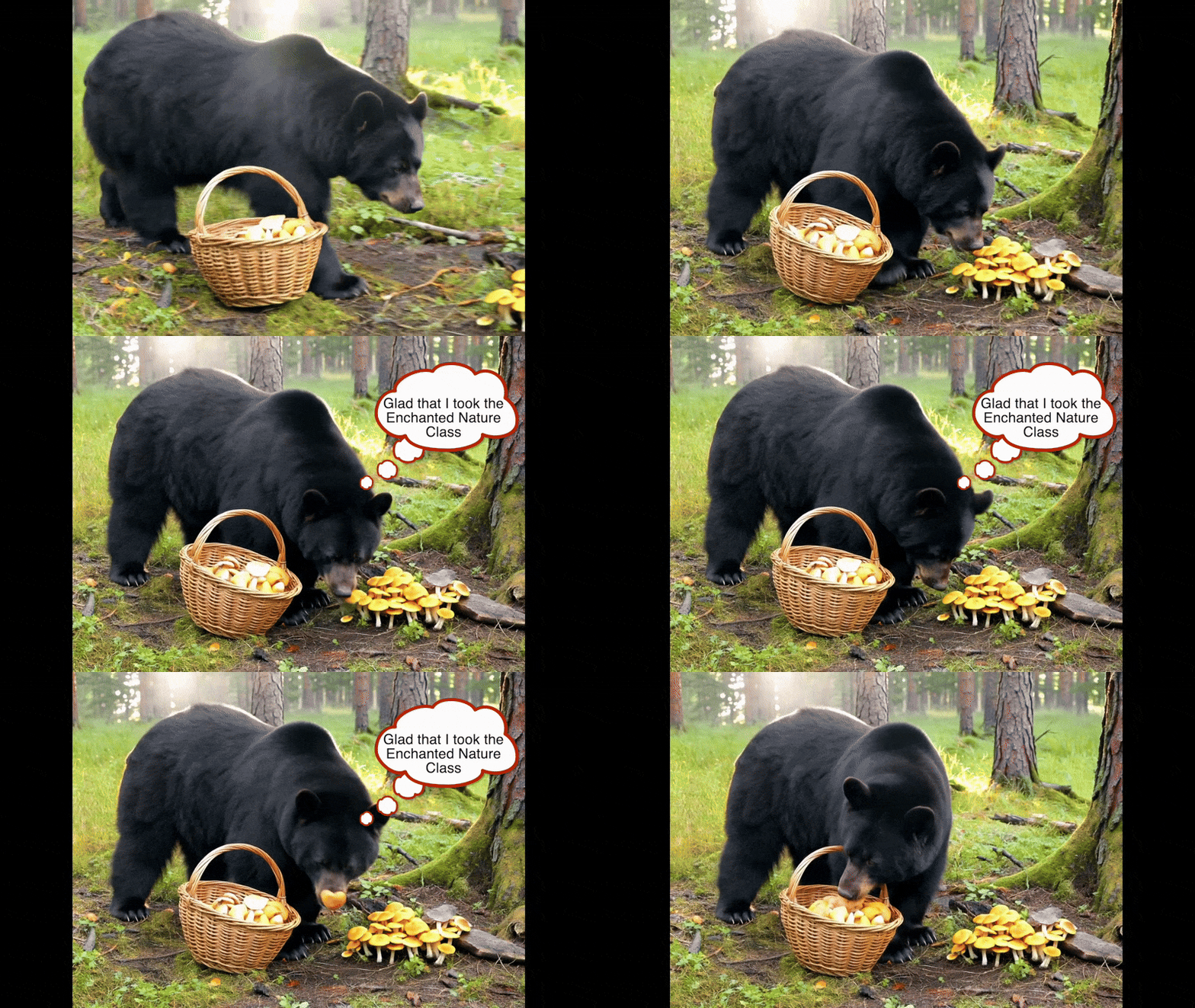
Turn A Hike Into A Culinary Treasure Hunt
Enchanted Nature's Introduction to Mycology and Mushroom Foraging Class
Sunday, July 26, 2026

Start Planning Now!
The Enchanted Mushroom Festival Is Coming
Saturday, October 3rd, 2026
Autumn is an extremely busy time here in the Shenandoah Valley.
Make your reservations and plans now to attend the festival.

Fungal Display at
June, 2026
Enchanted Nature is setting up a fungal exhibit in the display cases at The Staunton Public Library. It will be there for the month of June.

For those of you in the region, stop in to see us and our products at
3816 Churchville Avenue
Churchville, VA 24421
Thursdays, Fridays and Saturdays 10am-2pm

Enchanted Nature Mushroom Extracts:
Small batch, full spectrum
extracts made with whole fruiting bodies.
We source, forage or grow the mushrooms locally.
Our extracts can be purchased at:
The Necessary Mercantile, The Cheese Shop, or
you can order on The Enchanted Nature Trading Post


Connection
Here is a brief video we made of Tiger Swallowtail butterflies
gathering by a waterhole in a creek.
Nature is enchanting!
Findings reported in the International Journal of Environmental Research and Public Health, suggest that keeping a few snapshots of greenery around yourself might be beneficial. When participants viewed the natural images in the experiment, their stress levels lowered, thanks to the activation of their parasympathetic nervous system – which controls certain rest functions. "Viewing green scenes may thus be particularly effective in supporting relaxation and recovery after experiencing a stressful period and thereby could serve as an opportunity for micro-restorative experiences and a promising tool in preventing chronic stress and stress-related diseases."
Take a deep breath, hold it, and let it out slowly as you relax.
NATURE IS CALLING, WILL YOU ANSWER
There are many proven health benefits to spending time in nature. It has also been proven that just looking at images of nature can provide multiple health benefits including: reducing depression, speeding healing, improving your immune system, preventing dementia, improving your mood, and increasing happiness. We plan on ending each newsletter with a short video of a natural scene. Hopefully the videos will provide you with some of the benefits listed above.