

THE ENCHANTED NATURE NEWSLETTER

Issue 53
Summer 2026
Greetings Enchanted Nature Community
Children are back in school and summer has less than a month before the autumnal equinox on September 22, 2026. This season has brought some smiles and some challenges. Hopefully you have been taking some time to let nature enchant you. Enjoy the latest issue of
The Enchanted Nature Newsletter.
Is This The New Normal?
“"Nature is relentless and unchangeable, and it is indifferent as to whether its hidden reasons and actions are understandable to man or not." — Galileo Galilei
This last winter and now summer has brought with it some very challenging weather. Summer began with severe drought conditions. In July, damaging storms wreaked havoc on the farms and forests in our region. The fourth of July went from an enjoyable event to a horrific experience. Strong thunderstorms with damaging winds snapped trees like toothpicks while downpours fell in blinding sheets. The power was knocked out for a few days and mountains of work was left when the storms moved on. We are still dealing with the aftermath more than a month and a half later.
Around the world, extreme weather driven by climate change is becoming more intense, more frequent, and more deadly. Record-breaking heatwaves are pushing temperatures to dangerous levels and have already caused tens of thousands of deaths in Europe alone this year, while hotter oceans are fueling stronger storms and disrupting ecosystems. At the same time, prolonged droughts are drying out landscapes and turning forests into tinderboxes, leading to massive wildfires that are burning larger areas and with greater intensity than in the past . Elsewhere, heavier and more erratic rainfall is triggering catastrophic floods that displace hundreds of thousands of people in a matter of hours, as seen in parts of Asia. Scientists warn that these events are not isolated. They are part of a broader pattern caused by a warming planet, where rising global temperatures (now about 1.4°C above pre-industrial levels) are amplifying heat, drought, storms, and fires simultaneously. With additional factors like a strengthening El Niño, the world is now facing a future where “unprecedented” weather extremes may become the norm rather than the exception, affecting food supplies, infrastructure, and human health on a global scale.
The average person can help fight climate change by making practical, everyday choices: using less energy at home, choosing renewable power when possible, driving less or using public transportation, eating more plant-based foods, and reducing waste, all of which directly lower greenhouse gas emissions. Equally important, we can use our voices by voting, supporting climate-friendly policies, and influencing businesses; because collective action amplifies individual efforts into real systemic change. While no single person can solve the problem alone, research shows that these behavior shifts, especially when adopted widely, can significantly cut emissions and even offset a person’s entire carbon footprint in some cases. There is genuine reason for hope! People around the world are already making changes, clean energy is rapidly expanding, and studies show that when people believe their actions matter, they are more likely to engage and drive further progress. In short, climate change is a massive challenge but it’s one where millions of small, consistent actions, combined with growing global momentum, can and are making a meaningful difference.
From Our Readers
We sincerely appreciate your contributions!
Your photos make The Enchanted Nature Newsletter more interesting for the entire Enchanted Nature community.
If any of you see anything enchanting in nature, take a picture and please send it along.
Phil Crilley shared some of nice fungal photos for this newsletter.
The first pic is a Cauliflower Mushroom (Sparassis crispa). This is a choice edible, highly prized by chefs for its culinary value.

Clavulinopsis fusiformis, commonly known as golden spindles, is a striking grassland fungus recognized for its dense clusters of bright yellow to orange, finger-like fruiting bodies that resemble tiny flames rising from the soil. It typically grows in unimproved grasslands and pastures across Europe and North America, often appearing in autumn, and is considered an indicator species of low-nutrient, well-managed habitats. Although not known to be toxic, it’s generally regarded as inedible due to its small size and lack of culinary value, but it plays an important ecological role by contributing to soil health and biodiversity in these delicate grassland ecosystems.

In the last photo we see a Bolete mushroom and there are a few that look like this picture.
-
Bicolor Bolete (Baorangia bicolor): A popular edible fungus that typically grows near hardwood trees like oak. When its yellow pores or flesh are bruised, it stains blue very slowly and faintly.
-
Sensible Bolete (Boletus sensibilis): A toxic look-alike that causes severe gastrointestinal distress. It can be differentiated because its flesh and pores stain instantly and intensely dark blue upon the slightest touch or cut.
-
Pale-rose Bolete (Lanmaoa pallidorosea): Another look-alike native to North America. It features a slightly paler pink cap and also exhibits a rapid blue-staining reaction when injured.

Thanks for sharing your finds with the community Phil.
Below, Eileen Feim shared a cute video of a Marmota monax dining on her Morning Glory blooms.
You may know this rascal by his more common names: Groundhog, Woodchuck or Whistle Pig.
Cory Egger shared some lovely fungi for this summer newsletter.
Below we see a Shaggy Stalked Bolete (Strobilomyces floccopus).
It is recognized by its thick, shaggy, dark-scaled stem and large, sponge-like pores underneath a brown to olive cap. It is mycorrhizal with hardwood trees, often oaks, and is considered edible by some foragers when young, though its texture can become tough and it may cause gastrointestinal upset in certain individuals.

Amanita jacksonii is a bright orange to red-orange mushroom in the Caesar’s amanita group, found in hardwood forests across eastern North America. It has yellow gills, a yellowish stem, and a distinct sac-like volva at the base, along with a prominent ring on the upper stem. This species is considered choice edible by some experienced foragers.


Above, we see an incredible example of an entomopathogenic fungus at work. What looks like a strange orange root is actually the fruiting body of a Cordyceps mushroom bursting from its host; a subterranean insect pupa. This highly specialized parasite infects insects beneath the ground, slowly replacing their internal tissue before sending up a colorful club to release its spores into the wind.
Great finds Cory! Thanks for sharing with the community.
Thank you all for your submissions! May the forest be with you.
Remember, if you can't get enough fungal fun,
stop in and see us at The Necessary Mercantile
Please send us your pics and queries:
adventures@enchantednaturetours.com
You can also text your pics & questions to (540) 324-8778.
PLEASE INCLUDE YOUR NAME SO THAT WE CAN SAY THANK YOU
From The Writers
As we said above, the weather has been challenging and not only caused a lot of work with clean up, it caused some very serious damage to more than the trees.


Everything is Everything
By: Victoria Vacher
A long time ago a nineteen year old me came up with this concept and thought she was brilliant! Not knowing of course that it has been a topic of conversation since Plato and Aristotle and wasn’t at all new or brilliant! Teehee. But it was an eye opener for me at that age and most likely explains my lifetime of involvement with and study of nature.
Navigating the world right now I find myself taking comfort in the notion that perhaps this concept may be essential to our recovery. Surely the efforts and good works that so many wonderful people/organizations are carrying out throughout the world must be making a difference. People restoring ecosystems, communities planting trees, feeding the hungry, animals being returned to restored habitats, and so many more efforts to assist in renewal. Not to mention that the world is continually renewing itself.
Nature doesn’t exist as a collection of separate things. It consists of infinite webs of connection. Once we realize that, the concept becomes hopeful as every act of care becomes a part of a larger cycle of renewal. One kindness can create another, one person inspired by nature can inspire another, any positive act can become the foundation for another.
Our study of mycology reinforced this particularly lovely connection. Mushrooms are a nearly perfect symbol of this concept. So much of their work happens underground, out of sight. What we see in the fruiting bodies that appear above the ground is but a small part of the larger story.
Imagine a forest, a tree is not simply a tree. It is soil, rain, sunlight, fungi, insects, bacteria, microorganisms, carbon, etc. and time all working together. The mushroom below the tree is not merely a mushroom: it is a network of mycelium that participates in the life of the tree, the soil and other organisms. There are endophytic fungi living in the tree like there is fungi living in our human gut.
Nothing exists on its own. Everything gives something, receives something and becomes something else. Improvement happens not in isolation but in connection. Much of the most important work in nature happens quietly, invisibly and without recognition. So I choose to believe that maybe the world is being improved daily in countless ways that we cannot see. Underneath things are already happening and the visible change will come later.
Everything is connected to everything. Relying on this concept helps me to continue to do my part in participating in the renewal. That and remembering the famous quote from anthropologist Margaret Mead, “Never doubt that a small group of thoughtful, committed citizens can change the world; indeed it is the only thing that ever has.”

Enchanted Nature News
A Phase 2 Clinical Trial for Turkey Tail Mushrooms
This phase II trial tests how well turkey tail mushroom (TTM) works in treating post-menopausal women with HER2-negative, estrogen receptor (ER)-positive breast cancer undergoing surgery. TTM is a common mushroom. In traditional Chinese medicine, it is used for enhancing function and removing toxins, as well as for cancer, hepatitis, and infections. There is previous evidence of significant tumor shrinkage occurring in the 2-month window between diagnosis and surgery in women who have taken TTM. Giving TTM may be effective in treating post-menopausal women with HER2-negative, ER-positive breast cancer undergoing surgery.


FREE RESOURCES
We have added new educational resources.
There are lots of free field guides and other information waiting for you
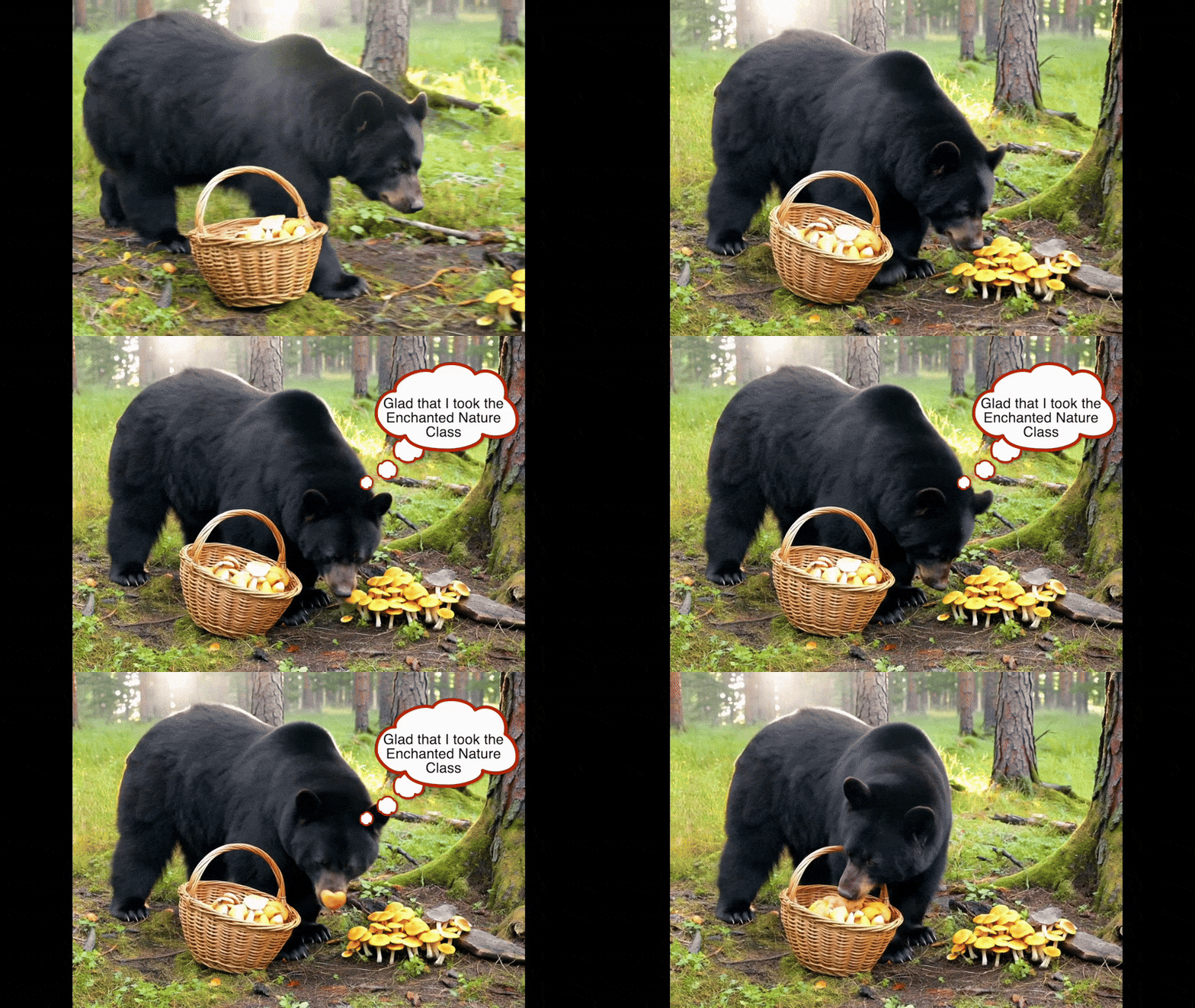
Turn A Hike Into A Culinary Treasure Hunt
Enchanted Nature's Introduction to Mycology and Mushroom Foraging Classes
Sunday, October 25 or November 29, 2026

Start Planning Now!
The Enchanted Mushroom Festival Is Coming
Saturday, October 3rd, 2026
Autumn is an extremely busy time here in the Shenandoah Valley.
Make your reservations and plans now to attend the festival.

Mycoremediation Project
Recently, we put together a team of volunteers from various disciplines and completed a lab test to study the efficacy of using Oyster Mushroom (Pleurotus ostreatus) colonized media to filter water with elevated levels of Escherichia coliform (E. Coli)...The results were ASTOUNDING!

OUR NEW
IS AVAILABLE EXCLUSIVELY AT
3816 Churchville Avenue
Churchville, VA 24421
Thursdays, Fridays and Saturdays 10am-2pm


IT'S OFFICIAL
The Enchanted Nature logo has been approved and registered
with the United States Patent and Trademark Office.
After a long and somewhat frustrating process, we finally
received our approval. You may begin to see our logo with the
familiar little ® symbol.
Enchanted Nature Mushroom Extracts:
Small batch, full spectrum
extracts made with whole fruiting bodies.
We source, forage or grow the mushrooms as locally as possible.
Our extracts can be purchased at:
The Necessary Mercantile, The Cheese Shop, Polyface Farms or
you can order on The Enchanted Nature Trading Post


Participation
Everything is truly connected and nothing we do is ever isolated or lost. Every effort to heal land, restore balance, or show care for another living thing becomes part of a much larger unfolding story; one that stretches far beyond what we can see or measure in a single lifetime.
Even in times that feel uncertain or overwhelming, there is comfort in remembering that renewal is already happening in countless subtle ways, often beneath the surface and out of sight. Like the mycelial networks beneath a forest floor, the impact of our actions may travel farther than we will ever fully know, quietly linking into something greater. So we keep going, not because we can control the outcome, but because participation itself matters.
In that participation, there is meaning, connection, and hope.
Mushrooms have been participating in cleaning up and healing the planet for millenia.
This video: 6 Ways That Mushrooms Can Save The World is one of our favorites.
Findings reported in the International Journal of Environmental Research and Public Health, suggest that keeping a few snapshots of greenery around yourself might be beneficial. When participants viewed the natural images in the experiment, their stress levels lowered, thanks to the activation of their parasympathetic nervous system – which controls certain rest functions. "Viewing green scenes may thus be particularly effective in supporting relaxation and recovery after experiencing a stressful period and thereby could serve as an opportunity for micro-restorative experiences and a promising tool in preventing chronic stress and stress-related diseases."
Take a deep breath, hold it, and let it out slowly as you relax.
NATURE IS CALLING, WILL YOU ANSWER
There are many proven health benefits to spending time in nature. It has also been proven that just looking at images of nature can provide multiple health benefits including: reducing depression, speeding healing, improving your immune system, preventing dementia, improving your mood, and increasing happiness. We plan on ending each newsletter with a short video of a natural scene. Hopefully the videos will provide you with some of the benefits listed above.